
The idea
The Box is one of the simplest and most reliable penalty-killing systems. Its purpose is to protect the dangerous areas of the ice, take away passes through the middle, and force the power play to make plays from the outside.
The setup
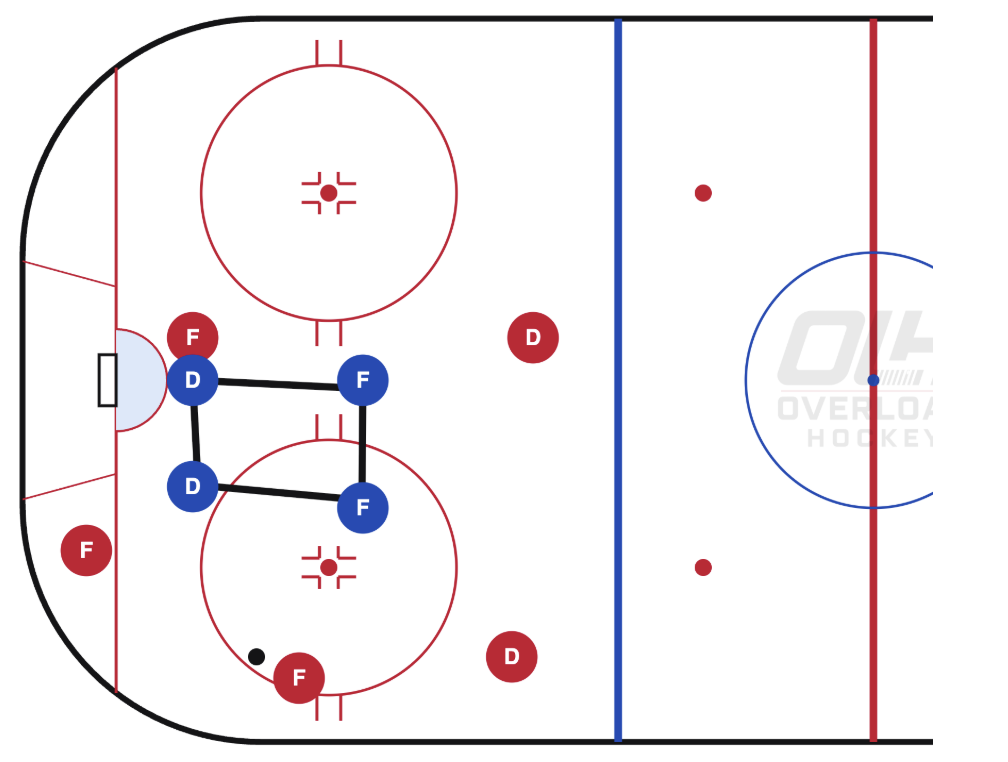
The four penalty killers form a box in front of the net. The two forwards make up the top of the box and are responsible for the opposing defensemen and players operating high in the zone. The two defensemen form the bottom of the box and protect the slot, net front, and players positioned below the goal line.
The four players must stay connected. As the puck moves around the offensive zone, the entire box shifts with it.
When the puck is up top
When the puck is at the blue line, the two forwards stay high enough to challenge the point while still protecting passes into the middle. The closest forward pressures the puck carrier without getting pulled completely out of the box. The other forward slides toward the middle and protects the seam, while the defensemen stay compact around the net and slot.
An outside point shot is acceptable when the goaltender has a clear view. An uncontested shot or pass from the middle of the ice is not.
When the puck goes to the half wall
When the puck moves to the half wall, the entire box shifts toward that side. The strong-side forward pressures the puck carrier. The strong-side defenseman protects the lower part of the zone and prepares for a pass toward the goal line or net front. The weak-side forward moves toward the middle and protects the seam, while the weak-side defenseman protects the back door.
Discipline matters in this position. Two players cannot attack the puck carrier and leave an opponent open in the middle.
When the puck goes below the goal line
The penalty killers do not chase the puck behind the net. The defensemen protect the posts and net front while the forwards collapse slightly toward the slot. The player behind the net must bring the puck into the coverage or move it back outside.
The greatest danger is not the player standing behind the net. It is the pass from behind the net into the slot or across to the back door.
The box moves together
Think of the four penalty killers as being connected by a rope. If one player moves, everyone adjusts. When the puck moves right, the box shifts right. When it moves left, the box shifts left. When it goes high, the box expands slightly. When it goes low, the box collapses toward the net.
The penalty kill applies pressure without losing its shape.
Sticks take away passing lanes
The stick is one of the most important tools on the penalty kill. Sticks stay inside the box and in passing lanes rather than reaching toward the puck carrier. This discourages passes through the middle and forces the power play to move the puck around the outside.
Players move as the pass is being made, not after the next player receives it.
What the box gives up
The power play can have perimeter possession, low-percentage shots from outside, and passes around the outside of the box. The box cannot allow seam passes through the middle, passes into the slot, back-door passes, uncontested net-front chances, or second and third opportunities after rebounds.
The goaltender handles visible outside shots. The four penalty killers protect the dangerous ice around the goaltender.
When possession is won
Once possession is gained, the first priority is to clear the zone. Avoid a dangerous play through the middle in an attempt to create offense. Get the puck past the blue line, change if necessary, reset the box, and make the power play travel the full length of the ice again.
The key
The Box works because of patience and discipline. The puck does not need to be won immediately. Protect the dangerous ice, stay connected, and wait for the power play to make a mistake.
What to look for
- Four penalty killers form a connected box in front of the net
- The entire box shifts with the puck while protecting the middle
- Outside possession and visible perimeter shots are acceptable
- Seam passes, slot chances, back-door plays, and rebounds must be denied
- Move as the pass is being made, not after the catch
- Clear the zone safely as soon as possession is won
Coaching cues
- Protect the house
- Sticks inside
- Move on the pass
- Four players move as one
- Do not chase behind the net
- Weak side protects the back door
- Give the goaltender the outside shot
Common mistakes
- One penalty killer chases and pulls the box out of shape
- Two players attack the puck carrier and open the middle
- Sticks reach outside the box instead of closing inside lanes
- The weak side loses the back-door player
- The box reacts after the pass instead of moving with it
- A risky clear is attempted through the middle
- Rebounds are watched instead of cleared
Related content
Breakout: Slash
Breakout: Slash
A simple breakout that creates three clear options: the wall, low support, and a weak-side slash through the middle.
Defensive Zone: Hybrid Coverage
Defensive Zone: Hybrid Coverage
Three defenders cover low while two forwards protect high; when the puck moves above the circles, all five switch to man-to-man.
Defensive Zone: Swarm & Blitz Pressure
Defensive Zone: Swarm & Blitz Pressure
A coordinated pressure trigger that outnumbers a vulnerable puck carrier, wins possession, and quickly turns defense into offense.