Overload Hockey
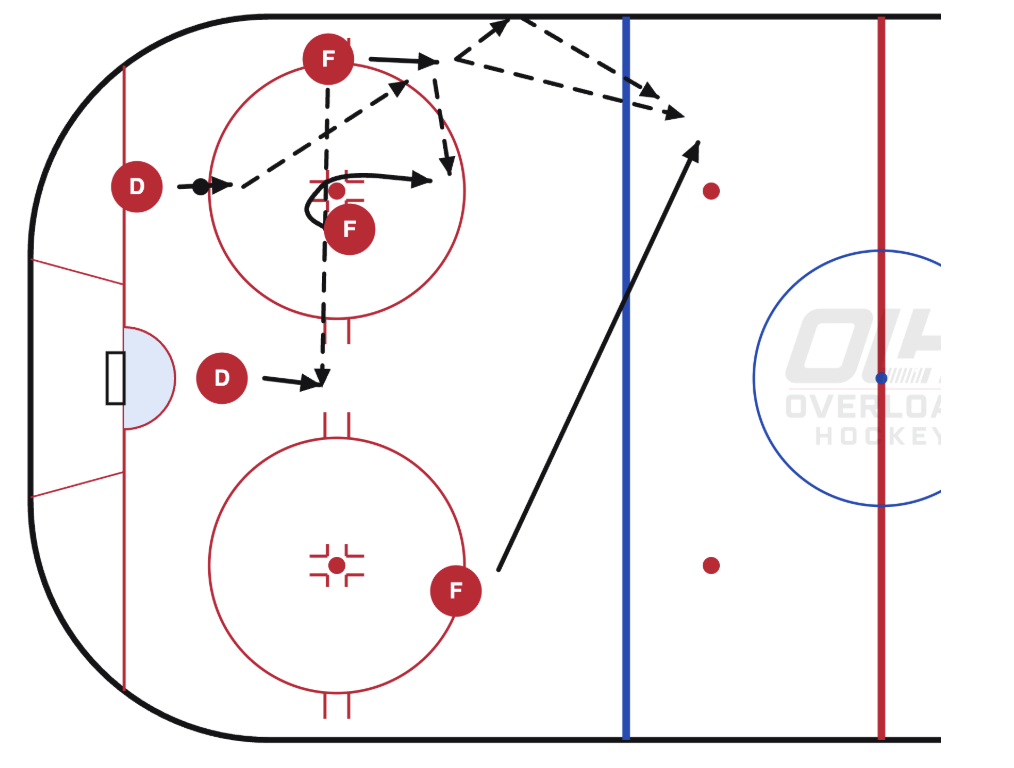
The Slash is a simple breakout designed to create multiple passing options through the middle of the ice while still giving the defenseman a safe outlet along the wall.
The defining movement is the weak-side winger slashing diagonally across the zone toward center ice. At the same time, the strong-side winger holds the wall and the center comes low and slow underneath the puck.
The goal is to give the defenseman three clear options and exit the zone with possession rather than simply throwing the puck out.
The Setup
When the defense retrieves the puck:
Strong-side winger = Wall
Center = Low and slow
Weak-side winger = Slash
The second defenseman supports the puck and remains available as a D-to-D option if needed.
The forwards should time their routes so they are moving and available when the defenseman is ready to make the first pass.
D1 — Retrieve the Puck
The first defenseman back retrieves the puck.
The first job is to gain control and identify pressure. Get the feet moving and the eyes up.
Whenever possible, turn away from pressure and create enough separation to make a controlled first pass. Do not automatically throw the puck up the wall.
D2 — Support
The second defenseman provides an outlet behind or across from D1.
Stay available. If D1 is under heavy pressure, communicate and become the easy option.
A D-to-D pass can change the entire side of the breakout and give the forwards time to adjust their routes.
D2 = support and safety.
Strong-Side Winger — Hold the Wall
The strong-side winger gives D1 the direct outlet.
Get to the wall and present a target. Do not drift into the middle too early.
Holding the wall stretches the forecheck and creates space for the center and weak-side winger underneath.
After receiving the puck, get the head up immediately. Skate it, move it to the center, or find the weak-side winger moving through the middle.
Strong-side winger = wall option.
Center — Low and Slow
The center comes back low and slow through the middle of the zone.
Do not fly out of the zone looking for offense. Be the support underneath the puck.
Stay below the puck and give the defenseman and strong-side winger an easy center-lane option. This positioning also provides puck support if possession is lost.
Center = low support.
Weak-Side Winger — Slash
This movement defines the breakout.
The weak-side winger starts on the opposite side of the ice and slashes diagonally across the zone toward center ice.
Time the route. Do not leave the zone too early. Arrive through the middle as the defenseman is ready to move the puck.
The slash forces the forecheck to make a decision and creates a moving target through the middle of the ice.
If the middle opens, hit the slash. The weak-side winger can receive the puck in stride and attack through the neutral zone with speed.
The Three Options
Once D1 has possession, three clear options should be available.
- WALL — The strong-side winger holds the boards and provides the safe first pass.
- LOW — The center comes underneath the puck as support.
- SLASH — The weak-side winger cuts diagonally through the zone and becomes the attacking option through the middle.
The defenseman does not need to force any particular option. Take what the forecheck gives.
If the Wall Is Open
Make the simple play.
D1 moves the puck to the strong-side winger. The center supports underneath. The weak-side winger continues the slash and becomes an option through the middle.
The winger can skate the puck out or use either supporting forward.
If the Middle Is Open
Attack it.
If the forecheck takes away the wall and leaves the middle available, D1 can hit either the center underneath or the weak-side winger on the slash.
The slash is especially dangerous because the winger is already moving toward center ice. Catch the pass in stride and go.
If D1 Is Under Heavy Pressure
Do not force the breakout. Use D2.
Move the puck behind the net or D-to-D and change the point of attack.
When the puck changes sides, the forwards adjust. The new strong-side winger becomes the wall option. The center stays underneath. The opposite winger becomes available through the middle.
Pressure dictates the breakout.
Timing
Timing is everything.
The strong-side winger cannot leave the wall too early. The center cannot get above the puck. The weak-side winger cannot slash through the zone before the defenseman is ready.
The options should appear as D1 gets the head up. If everyone leaves early, the defenseman has nobody to pass to.
Why the Slash Works
The forecheck has to defend the entire width of the ice.
The wall option stretches the forecheck outside. The center provides support underneath. The slash attacks the space between defenders.
Instead of three forwards simply skating straight up the ice, the Slash creates layers of support at different depths. That gives the puck carrier options.
If the First Pass Is Taken Away
Stay patient. Do not force a puck into traffic simply because the Slash is being run.
Reverse it. Go D-to-D. Come back underneath. Reset the routes.
The system creates options; it does not require them to be forced.
Once the Puck Breaks the Blue Line
Go.
The breakout structure is finished once possession is established outside the zone.
The puck carrier attacks with speed. The other forwards fill lanes and support the puck. The defense joins underneath.
Turn the breakout into transition offense.
The Identity
The Slash gives the puck carrier simple, predictable options while forcing the forecheck to defend multiple areas of the ice.
WALL. LOW. SLASH.
Everyone knows where the support is coming from, and the defenseman makes the read.
What to look for
- D1 controls the puck, identifies pressure, and makes the available read.
- D2 stays available behind or across as support and safety.
- The strong-side winger holds the wall as the direct outlet.
- The center stays low and slow underneath the puck.
- The weak-side winger times a diagonal slash toward center ice.
- The three reads are WALL, LOW, and SLASH.
Coaching cues
- Strong side = WALL.
- Center = LOW AND SLOW.
- Weak side = SLASH.
- D2 = support.
- Timing over speed.
- Get below the puck.
- Do not leave early.
- Take what the forecheck gives.
- Hit the slash when it is available.
- Exit with possession.
Common mistakes
- D1 automatically throws the puck up the wall instead of reading pressure.
- D2 becomes unavailable as the safety outlet.
- The strong-side winger drifts into the middle too early.
- The center gets ahead of or above the puck.
- The weak-side winger slashes before D1 is ready.
- The first pass is forced into traffic instead of reversed or reset.
- Multiple forwards occupy the same lane.
Related content
Defensive Zone: Hybrid Coverage
Defensive Zone: Hybrid Coverage
Three defenders cover low while two forwards protect high; when the puck moves above the circles, all five switch to man-to-man.
Defensive Zone: Swarm & Blitz Pressure
Defensive Zone: Swarm & Blitz Pressure
A coordinated pressure trigger that outnumbers a vulnerable puck carrier, wins possession, and quickly turns defense into offense.
Powerplay: 1-3-1

Powerplay: 1-3-1
A power-play formation that spreads five players across different levels of the offensive zone — top, two flanks, bumper and net front — creating passing triangles and forcing the penalty kill to defend inside and out.