
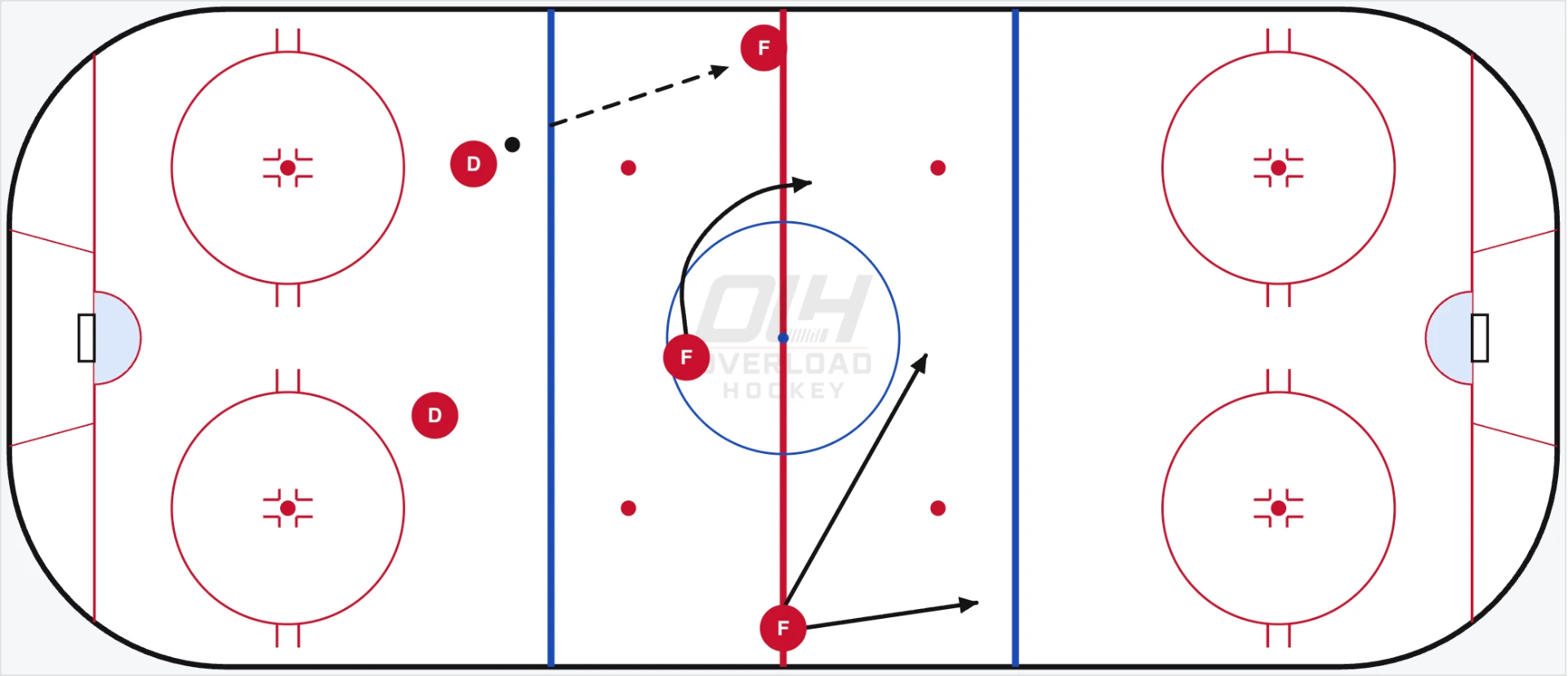
The quick up is the first look on every regroup. The D has the puck below the blue line with time, and the strong-side forward is already turning up the boards. Before the pressure arrives, the puck goes up to him and the play is going the other way.
Reading the diagram: the puck is on D1 just inside our blue line. The center curls out of the middle of the ice and comes back toward the puck, then turns up so he is moving forward when the winger receives it. Strong side winger is already high, stretching the far side of the red line so the opponent cannot collapse on the wall. Weak side winger is low and wide, giving two more options: the diagonal into the middle lane or the straight-line route up his own wall.
The whole point is time. The quick up only works if the puck moves before the forecheck reloads, and it only works if the receiver is skating. A quick up to a stopped forward is a turnover at our blue line.
What to look for
- Move the puck on the first look — the quick up dies if the D holds it
- The receiving winger must be turned up ice and moving before the pass arrives
- Strong Side Winger stretches high to hold the opponent's D back and open the wall
- Weak side winger gives a second lane if the first wall is covered
Coaching cues
- Puck up before pressure
- Receive it moving, not standing
- Stretch high to open the wall
- Head up on the catch — the middle is often open
Common mistakes
- Forward stops on the wall and gets pinned
- D skates into pressure instead of releasing the puck
- All three forwards on the same side of the ice
- Pass into the receiver's feet instead of ahead of him
Related content
Breakout: Slash

Breakout: Slash
A simple breakout that creates three clear options: the wall, low support, and a weak-side slash through the middle.
Defensive Zone: Hybrid Coverage
Defensive Zone: Hybrid Coverage
Three defenders cover low while two forwards protect high; when the puck moves above the circles, all five switch to man-to-man.
Defensive Zone: Swarm & Blitz Pressure
Defensive Zone: Swarm & Blitz Pressure
A coordinated pressure trigger that outnumbers a vulnerable puck carrier, wins possession, and quickly turns defense into offense.