What this is
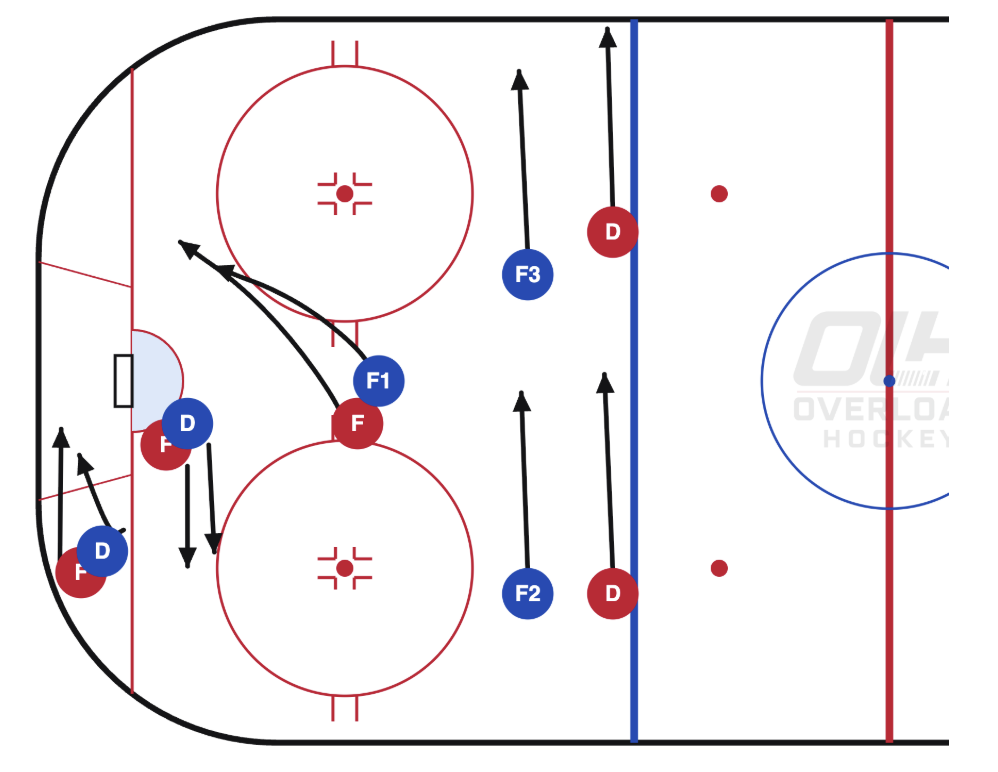
Man-to-man is an aggressive defensive-zone system built around one simple rule: everyone has a man. Each defender identifies an offensive player and stays responsible for that player wherever they move in the defensive zone. This is not defending an area — it is defending people. The goal is to eliminate time and space, stay tight to assignments, and make it difficult for the offensive team to create an open player anywhere in the zone. For a structure that mixes man and zone principles, compare this with Low Defensive Zone: Hybrid Coverage, and for an all-out pressure alternative see Defensive Zone: Swarm & Blitz Pressure.
The setup
When the opponent establishes possession in the defensive zone, all five players identify their responsibility. Typically D1 takes offensive forward #1, D2 takes offensive forward #2, the center takes offensive forward #3, and the two wingers take the opposing defensemen. Once a defender has a player: stay with them. If they move, you move. If they go behind the net, go with them. If they move into the slot, stay with them. If a defenseman walks down from the blue line, the winger responsible for that defenseman follows down.
Puck carrier — pressure
Whoever is responsible for the puck carrier pressures the puck. Close quickly, take away time and space, keep a good defensive stick, and stay on the defensive side of the assigned player. The puck carrier should never have time to get their head up and make a play. Puck equals pressure. Everyone else stays tight to their assignment.
Away from the puck — stay with your man
Do not become a puck watcher. A defender's responsibility does not disappear because someone else has the puck. Know where the assigned player is and stay close enough that if the puck arrives, pressure is immediate. The biggest breakdown in man-to-man coverage happens when defenders start watching the puck and lose their assignment. See the puck, feel your man.
Defensemen — low coverage
The defensemen generally begin with the opposing forwards playing low in the zone. Stay on the defensive side and protect the net. If the assigned player cycles into the corner, go with them. If they move behind the net, stay with them. If they rotate higher in the zone, continue with them unless a switch is clearly communicated. A defender does not leave an assignment simply because that player leaves the area the defender normally defends. The responsibility is the player, not the position.
Center — third forward
The center generally takes the third offensive forward. That player may be supporting the puck, moving through the slot, or rotating through the cycle. Stay connected and avoid staring at the puck while the assigned player slips into open ice. If that player rotates low, go low. If they rotate high, stay with them. Find them and stay with them.
Wingers — opposing defensemen
The wingers are responsible for the opposing defensemen, and this is one of the biggest differences between man-to-man and zone coverage. If the defenseman stays at the blue line, stay with them. If they walk down the wall, go with them. If they activate all the way into the corner, go with them. Do not release them simply because they have entered another part of the zone. In man coverage, the assigned player is the responsibility wherever they go.
When players cycle
Stay with the assignment. The offense will use cycles, rotations, and switches to create confusion, and their movement does not change the defending team's responsibilities. If the assigned player cycles from the corner to the wall, go with them. If another player replaces them, the teammate responsible for that player stays with them. The coverage does not automatically rotate just because the offense rotates.
Switching
There will be situations where two offensive players cross or exchange positions, and assignments can be switched when it makes sense — but the switch must be clear and communicated. Call "SWITCH" and make sure both defenders understand the exchange. Never assume a teammate has taken an assignment. If there is no communication, stay with the original player. A bad switch creates an open player in the most dangerous part of the ice.
When the puck goes behind the net
Stay with the assignments. If the assigned player carries the puck behind the net, follow them. The other defenseman stays responsible for their player around the net front, the center stays with the third forward, and the wingers remain responsible for the defensemen. Do not have all five players collapse toward the puck: one player pressures the puck while four handle their assignments.
Net front
Inside positioning is critical. Whenever an assigned player goes to the net, get between that player and the goaltender, control their stick, take away rebounds, and prevent tips. Never allow that player to establish position behind the defender. Man-to-man does not mean standing beside someone — stay on the defensive side.
When a defenseman activates
This is where man coverage has to be obvious. If the opposing defenseman walks down from the blue line, the winger responsible goes with them — even below the circles, even behind the net, even when it looks strange positionally. The defending team is not defending positions; it is defending players. That is one of the clearest distinctions between man-to-man and zone coverage.
Do not get picked
Offensive teams will create traffic and use crossing routes to separate defenders from their assignments. Anticipate it, stay on the defensive side, and communicate when players cross. If a clean switch is available, switch. If it is not, fight through and stay with the assigned player. One screen or pick should never create a free player going to the net.
If the assigned player gets the puck
Close immediately. There should be very little delay between an offensive player receiving the puck and feeling pressure — that is one of the biggest strengths of man coverage, because every offensive player already has someone close to them. The opponent should feel no time, no space, and no easy plays.
When possession is won
Coverage is over. Do not continue following the assigned player. Transition immediately: find support, get available, and move the puck. Because man coverage can pull players into unusual areas of the zone, all five have to recognize the change of possession quickly and get into the breakout. See Defensive Zone Exits and Breakout Principles for the next touch.
Communication
Man-to-man is simple, but it requires constant communication. Standard calls are "I'VE GOT HIM", "SWITCH", "STAY", "PUCK", and "NET". Never assume somebody else knows who a defender has. All five players should know exactly who they are responsible for.
The biggest rule
Do not lose an assignment while watching the puck. The puck cannot score by itself. The responsibility is making sure every offensive player is accounted for: pressure the puck when it is your man, and stay attached when it is not. The identity of this coverage is simple — find him, stay with him, beat him. Every player has one responsibility, and winning individual matchups is how the defensive zone is won collectively.
What to look for
- Everyone has a man: D1 and D2 take the low forwards, the center takes the third forward, and the wingers take the opposing defensemen.
- The defender responsible for the puck carrier pressures immediately while the other four stay tight to their assignments.
- Assignments follow the player anywhere in the zone, including behind the net and into the corners.
- Wingers track activating defensemen all the way down the wall, even below the circles.
- Switches happen only when both defenders communicate; with no call, stay with the original player.
- Net-front coverage means inside body position, stick control, and denying rebounds and tips.
- When possession changes, coverage ends and all five players move immediately into the breakout.
Coaching cues
- Everyone has a man.
- Find your assignment.
- Stay with your man.
- Puck equals pressure.
- Stay defensive side.
- Do not puck watch.
- Wingers follow activating D.
- Switch only with communication.
- Protect the net.
- Win your 1-on-1.
- Possession changes equal breakout.
Common mistakes
- Watching the puck and losing the assignment in open ice.
- Releasing an activating defenseman at the hashmarks instead of tracking them low.
- Switching without a call, leaving two defenders on one player and someone free in the slot.
- Everyone collapsing toward the puck behind the net instead of holding assignments.
- Standing beside the net-front player instead of taking inside position.
- Leaving an assignment because that player moved out of the defender's usual area.
- Continuing to follow a player after possession is won instead of transitioning to the breakout.
Related content
Breakout: Slash

Breakout: Slash
A simple breakout that creates three clear options: the wall, low support, and a weak-side slash through the middle.
Low Defensive Zone: Hybrid Coverage
Low Defensive Zone: Hybrid Coverage
A connected 3-on-3 below the circles with two forwards protecting high, switching to man-to-man coverage when the puck moves above the circles.
Defensive Zone Zoning and Danger Areas

Defensive Zone Zoning and Danger Areas
How the defensive zone is scored by danger: high danger, medium danger inside and outside home plate, the swarm corners, and low danger along the wall.